Ladakh, the region of high passes is situated at 10,000 feet in the state of Jammu & Kashmir. There is no place like Ladakh in the whole world where the climate has a sharp contrast. It experiences arctic like cold in the winters (October to April) when the temperature goes down to – 20 to – 30 degree Celsius while in summers (June to September) when most of the days are warm and the temperature during the day varies between a maximum of 15 – 30 degree Celsius to a minimum of 5 – 15 degree Celsius, depending on the altitude of a place.
Landscape of Ladakh during summer season.
So if you are planning to travel to Ladakh and are wondering which is the best month to travel there? Then we at Trip Platform have prepared a month – on – month breakdown of the weather in Ladakh, which would be informative for all types of travelers i.e. the regular tourist and the adventure seekers and accordingly they can plan their travel anytime during the year. Also travelers have a keep in mind that a trip to Ladakh cannot be a weekend getaway or a three day short trip, visiting Ladakh needs a minimum of 8 – 10 days.
Winter (October to April) is very inhospitable as the mercury level comes down and heavy snowfall is a common occurrence.
Summer (June to September) is the ideal season when all road passes are open. The weather is cool and pleasant; skies are clear and offer panoramic views of the mountains.
Monsoon is not limited to any particular season; it is erratic and may occur at any time.
The Best season to visit Ladakh is from June to September. But each month or season offers something unique to travelers, which has been explained in detail below.
June:
By June all road routes are open i.e. Srinagar – Leh highway opens by the mid May and Manali – Leh highway opens up in June. The month of June is the best time as there is still plenty of snow around while the sun shines brightly and keeps the day temperatures warm.
This is when tourism begins to pickup and the town of Leh is suddenly buzzing with visitors from all over the world, most of them are on month long treks and pan Ladakh expeditions. During this month tourist can get a glimpse of a few local festivals celebrated i.e. the famous Hemis Festival and the Sindhu Darshan Festival.
July:
The advantage of traveling in July is that during the first couple of weeks you will still get to see snow en-route at Rohtang La and Baralacha La and the road towards Leh is in much better condition than it was in the month of June. Adding to it the temperature in Leh and other parts of Ladakh is lot warmer and pleasant, but this is the time when Ladakh starts receiving occasional downpours which can make roads slightly treacherous.
For tourist who are interested in trekking, the peak season for Ladakh trekking starts now and you can now explore nature, the mighty Himalayan range and the cold deserts all at their best. Also around this time the passes on the Manali – Leh Highway and the Srinagar – Leh Highway become completely motor able and are much easier to travel on. During the month of July visiting tourist can enjoy the Stongday Gustor Festival held at the Stongdey Monastery.
August:
With summer at its peak and roads in good condition all over Ladakh, the month of August is considered to be the best. During this period most farms in and around Leh, Nubra Valley, Suru and Zanskar Valley and Srinagar – Leh Highway are full of lush greenery, thus providing a nice contrast between the arid mountains and lush green fields.
During this month there is less chance of roads getting closed barring Zoji La, Rohtang La and Baralacha La, which are affected by monsoon rain, landslides and cloud bursts. However, the weather is pleasant during August and Ladakh receives maximum number of tourist during this time, incase tourist are looking for a more peaceful and quieter stay then they can opt for a visit later in the season. If you happen to be traveling somewhere around the end of August, make sure you have packed a few extra woolens as the breeze during this time is a lot more gustier and carries a lot of bite.
Tourist must also note that if they are using the Srinagar – Leh highway to reach Leh, the months of July and August could be very busy due to the bulk of pilgrims going for the Amarnath Yatra,
September:
Unlike the months of July and August, September is not considered the best time to visit Ladakh, since it indicates the return of the winter season, and the weather starts turning cold. Moreover the high altitude passes start receiving snowfall and even the Pangong Tso can experience snowfall. Due to this, fewer tourists visit or remain in Ladakh.
However for adventure enthusiast, September can be best month to visit Ladakh, since roads are yet at their best and there are fewer tourists around, tourist will find Ladakh peaceful and a solace that will be unparalleled making their trip even more special.
View of the Nubra Valley
During this time most valleys like Nubra, Suru and Zanskar Valleys undergo transformation and grass and shrubs change from green to orange and even red in colour! Orange coloured grass contrasted against the deep blue sky, arid mountains and blue water makes it perfect time for photography.
The scenic Zanskar Valley in September
On the Manali – Leh Highway travel becomes a bit more risky from mid – September onwards due to mild snowfall and reduced options for accommodations and transport as many buses and taxis stop running. However, no one can predict what the nature has in store and at times severe rains and snowfall can occur due to western disturbance and local weather buildup, there have been incidents of bridges being damaged which lead to delays however, these incidents are more of an exception than a norm.
Locals during the celebration of the Ladakh Festival
The Ladakh Festival is held in Leh from 1st to 15th of September every year, and the festival features captivating street procession, polo matches, archery shows, cultural performances, and handicraft exhibitions. The Ladakh Marathon is another event in September wherein various running races in and around Leh take place between Indian and International competitors. The Nubra Festival is celebrated with folk music and dance in different villages across Nubra Valley.
Participants from various countries take part in The Ladakh Marathon held in September
So, between June to September remain the best months to visit Ladakh, especially for travelers who are looking for a comfortable stay, a travel on good roads and experience a pleasant climate.
As the month of October sets in it is already cold, the nights are back to being bitterly cold and during these months travelers require a desi angeethi or a central heating system to keep their rooms warm, as the days progress to November the temperature further drops resulting in heavy snowfall and all interstate city roads and passes get closed for the next 5 to 6 months.
December and January are the coldest months of the winter season, during this time the temperature during the day is about 2 degree Celsius and night are chilling at – 20 degree Celsius, the entire Ladakh landscape is covered by snow and thick sheets of ice are formed over rivers and lakes. This is the best time for hard core adventure enthusiast to undertake the world’s most adventurous treks ‘The Chadar Trek’.
The ChadarTrek on the frozen Zanskar River
The Chadar Trek is a popular trek with most adventure travelers both from India and abroad, and this trek starts from mid January and lasts until the end of February. The trek is organized on the Zanskar River which freezes by this time and forms a thick slab of ice on which travelers can walk with ease. The Chader trek ranges from 7 days to 21 days. The Hemis National Park that is open all round the year and it is ideal to visit during the winter months when travelers can spot the elusive snow leopard.
A rare sight of the Snow leopard at Hemis National park during Winter
As the month of February sets in there is little respite and during the month of March the weather starts getting better but it is still extremely cold although you will find a few shops and business establishments open and begin functioning by this time. The month of April is far better as the temperatures rises up to 12 degrees Celsius during the day, this is when the Indian army and other volunteer groups start clearing the snow for civilian traffic, but this process takes time and roads open up only by the end of May.
A Jawan takes part in clearing of snow operation on the Srinagar – Leh Highway in the month of April
So, Ladakh has its own charm during the winters as there are no tourists during this time and only travelers who are hard core adventure enthusiast visit Ladakh from all over the world. Ladakh can be reached only by air during this time and air fares generally are low.
A view of the internal roads in Ladakh during winter.
As both major routes to Leh close in winter, majority of the internal roads and highways within Ladakh remain open and places within Ladakh can easily be explored in a taxi even during the peak winter season. In case of Nubra Valley, Pangong Tso and Tso Moriri, travelers must keep in mind that the roads may get closed for couple of days or more in case of heavy snowfall. Hence during winters it is ideal to keep your plans a bit flexible and avoid traveling to the above attractions on the last day of your trip. Also travelers should keep an eye on the weather forecast and check with the locals about the prevailing weather and road conditions before they venture out on a trip.
Festival in Ladakh during winters:
Locals celebrating the Losar festival which is the beginning of the new year of Ladakh.
Losar Festival (December or January): This is a 15 day festival which marks the beginning of the new year of Ladakh.
Spituk Festival (January or February): A day festival of Gastor is celebrated in the Spituk Monastery.
Dosmoche Festival (February): This is a 2 day festival celebrated in Leh at venues like Leh Palace, Diskit and Likir monastery.
Nagrang Festival (March): The annual festival of Matho Nagrang is held in Matho Monastery which is about 26 kms from Leh.
Leh airport is accessible throughout the year from Delhi, Srinagar and Jammu, this is the ideal way to reach Ladakh even during peak winter season (November to April).
By Road:
Srinagar – Leh Highway: Mid May to September.
Manali – Leh Highway: July to September
Leh offers travelers a variety of accommodations to suit almost every budget and taste. Most midsized hotels are family run and their services are more personalized as compared to luxury hotels.
A Luxury Hotel in Leh.
Premium or High-end Hotels: These hotels are of top quality and offer full range of services and facilities. But currently there are very few High-end hotels in Leh to choose from.
Luxury Hotels: A 3 Star Hotel, these hotels are of moderate quality and have comfortable rooms and offer a good range of facilities and services. They are graded as A Class deluxe by the Locals in Leh.
Deluxe Hotels: A 2 to 3 Star Hotel, these hotels offer a limited range of facilities and reasonable comfort. They are graded as A Class by the Locals in Leh.
Economy or Budget Hotels: The facilities of these hotels will be limited and rooms will be of standard type. These hotels offer a friendly service which often takes care of for the lack of amenities.
A Guest House in Leh
Guest Houses: The guest houses are a less formal facility which offers rooms that is part of a residential house where guest can share the same kitchen for meals with the host. These accommodations are very basic but good and provide an opportunity for visiting tourist to witness and experience Ladakhi life from within.
In newly opened areas of Ladakh i.e. Nubra Valley, Changthang and Dah Hanu the tourist infrastructure is still not well developed.
Camps and Guest Houses remote areas:
These remote regions offer a variety of camping options only from June to September. The camp sites have been set up in beautiful locations and are close to nature. In Pangong campsites are just next to the Lake, while in Tso Moriri there are many options to choose from close to the lake. In Nubra valley campsites have come up in Hunder and Sumoor villages which give the traveler a real feeling of adventure.
A Campsite at Nubra Valley
The Tourist department of Jammu and Kashmir is working on building more accommodation facilities by building tourist complexes, Hiker’s hut’s at Tangse, Rumtse Spanmik, Panamik, Sakti, Hunder and Saspol villages.
A Hikers tent in Nubra Valley
Tourist can also opt for staying as paying guest in few selected houses but are advised to travel with personal sleeping bags and other provisions especially if they plan to stay overnight at Pangong and Tso Moriri lake areas.
An inner view of a typical tent
There are also a few Government run Tourist Bungalows located mainly along Srinagar – Leh road, which are budget friendly but need prior reservation and approval from Tourist office in Leh or Kargil.
A beautiful Guest House in the Nubra Valley
During peak tourist seasons i.e. June to September it is advisable to book hotel rooms in advance, by mid September the tourist rush begins to decline and accommodations are easily available without prior booking.
A water heating system at a Guest house in Ladakh.
However tourist planning to come during winter must ensure that they book in advance and ensure that the hotel is functional during the winter period (October to April) and have good provisions of heating arrangements during winters.
Accommodation at Pangong Tso:
During the peak season i.e. from June to September it may be difficult to get any accommodation without prior booking at Pangong Lake.
Tents by the banks of the Pangong Tso Lake.
If visitors wish to stay right near the banks of the Pangong Lake, then they can opt for a tent at a campsite else the best bet would be cheap home stays at Spangmik Village or Guest Houses / Hotels at Tangste village which is nearby to the Pangong. However, keep in mind the facilities at home stays and guest houses may be basic so it is advisable to carry your own sleeping bags in order to keep things hygienic.
A Guest House at Tangste Village
During winters campsites stop their operations on the Pangong Lake due to the extreme cold weather, hence during that time guest houses and home stays will only be available at Tangste village and Spangmik Village, before booking kindly insure that the guest houses/home stays/hotels have an internal heating system in place.
The Bollywood Connection:
Remember the block buster film 3 idiots, the entire crew of the film stayed at Dothguling Guest House in Tangste village for a few days in July 2009.The staff at the guest house happily took photographs of all actors / actresses having lunch / dinner at their guest house and now those snaps are on display all over the guest house for visiting tourist to see.
The Dothguling Guest House in Tangste village where Aamir Khan other stars and crew members of 3 – Idiots stayed.Inside Dothguling guest house where Amir Khan, R.Madhavan, Sharman Joshi & the 3 Idiots crew stayed while shooting at Pangong Tso.A picture of Aamir Khan on the wall with a member of staff at Dothguling Guest House. Kareena Kapoor’s room during the filming of 3 – Idiots at Pangong.
Such was the impact of the film 3 Idiots that tourism at the Pangong Lake has taken an all new dimension. Every year more and more film stars and film crews are arriving here for a shoot and overall there has been a sharp increase of tourist due to this latest trend set by Bollywood. When here, visiting tourists will surely get to hear many stories about film stars from the hotel owners and the hotel staff.
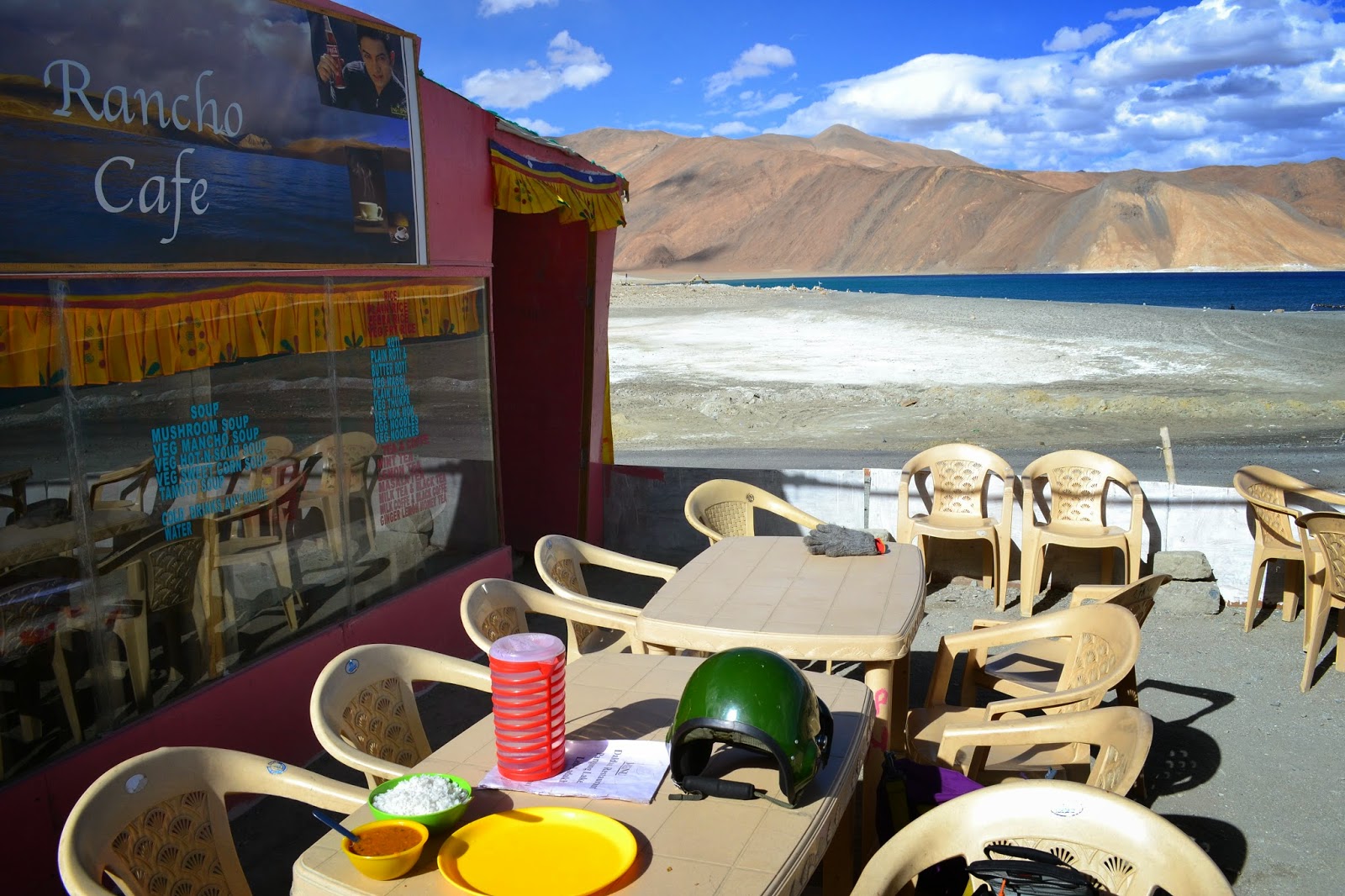
3 Idiots Cafe at Pangong Tso Lake Viewpoint.3 Idiots Cafe ‘Cheers to Aamir’
Big Budget Films that were shot in Ladakh are:
Tashan (Yash Raj), Dil-Se(Mani Ratnam), 3 – Idiots(Raj Kumar Hirani), LOC(J.P Dutta), Paap(Pooja Bhatt), Frozen (Danny Denzongpa) etc have been shot extensively in Ladakh showcasing the raw and untouched beauty of this place.
There is a famous saying in Ladakh “The land is so barren and the passes are so high that only our fiercest enemies or our best friends would want to visit us”
If you are planning to visit Ladakh and are confused on how you should reach, we at TripPlatform have prepared a complete travel guide along with other important information which will be useful and will eliminate all confusions going through your mind.
As you begin reading this article, you first have to decide on the number of days you will spend in exploring Ladakh region and the budget at your disposal and then opt from the best possible option for your travel.
By Air
A flight trip to Leh gives travelers a spectacular panoramic view of the snow – capped mountain ranges and the thrill of identifying popular valleys and landmarks below throughout their travel.
An aerial view of the mountain ranges of Ladakh
Ladakh’s capital Leh is well connected by flight services from New Delhi, Jammu and Srinagar and there are a number of airlines that operate regular scheduled flights.
Leh Airport.
Travelers must note that the weather conditions can be erratic in Leh and flights can get cancelled at a short notice. So travelers should check before traveling and book well in advance, since the flights are usually full during the summer months(June – September).
Merits of Air Travel :
Save on time.
Get a bird’s eye view of the Himalayan ranges and beautiful valleys.
Travel comfortably.
Demerits of Air Travel :
Air Travel is Costly.
Travelers could face health issues on reaching Leh due to a sudden change in altitude.
Reaching Leh is more about the road traveled and is less of a destination.
Lack of adventure as compared to a road journey.
Recommended months of Travel by Air : April to November is the best. But flights operate all round the year for Leh.
By Train
Jammu Tawi Railway Station
There are no direct trains to Leh (Ladakh); the nearest railway station is Jammu Tawi in Jammu which is about 700 km from Leh city. Jammu Tawi railhead is well connected with all major cities and towns of India.
By Road
Driving to Ladakh by road is one of the most exhilarating road adventures in India, as it involves driving through some of the world’s highest motor-able mountain passes, travel through vast semi-arid planes, barren mountains, sweeping valleys and stunning panoramas all around, while getting the glimpse of the nomads and tribes living in small hamlets all along the way.
Needless to say, the pictures you will post on the social media about your road trip will be an instant hit and for the rest of your life you will have something worthwhile to brag about.
There are two roads that bikers and drivers take to reach Leh town. One is the Srinagar – Leh Highway and the other is the Manali – Leh Highway.
Road from Srinagar to Leh
Distance : 434 km.
Approximate time : 10 hours (Travel time may differ depending on your mode of transport, halts taken en-route, weather & traffic conditions on the highway).
Best time to travel through this highway : June to November. (This route is closed from November onwards to May due to heavy snowfall).
2) Srinagar – Sonmarg – Drass – Kargil – Batalik – Dah – Skurbuchan – Leh. ( via Batalik & Dah an Inner-line permit is required from the DEC office in Kargil or Leh).
The Srinagar – Leh Highway is known as NH-1D and has been the lifeline for Ladakh region as it connects it to other parts of India via Kashmir Valley. As you travel along this Highway you will get a glimpse of the Indus River flowing along and you will also come across a number of passes, the major ones being the Zozi La Pass @ 11,500 feet, Fotu La Pass @ 13,000 feet and Namki La Pass @ 12,500 feet above sea level.
Travel modes on Srinagar – Leh Highway.
Privately Owned Vehicles – Self Driven (Cars and Bikes).
It is a dream for most drivers (car) and bikers to drive on this highway as it is an experience of a lifetime, tourist can opt for rented cars or bikes that are easily available. An SUV/MUV or En-field bikes are ideal vehicles on this route, but it is advisable for travelers to know about the maintenance of the vehicle they are driving in case of any trouble with the vehicle which may occur during the journey.
Engage a Private Taxi
Tourist can book their taxis at Srinagar from tour operators and reach Leh comfortably.
Srinagar – Leh Bus Service
Bus plying between Srinagar and Leh.
Tourist can board the JKSRTC buses from Srinagar Bus Stand (i.e. near Lal Chowk), this is one of the cheapest mode of transport for reaching Leh. Semi-Deluxe and Private Buses can be booked from Private bus operators in Srinagar. Buses generally leave early in the mornings with halts at Sonmarg and Kargil.
Shared Taxi Services
Tourist can also opt for shared taxi services which start from Srinagar and is ideal for single or budget travelers. These shared taxis ferry about 6 people along with the driver. Shared taxis generally start their journey at midnight and reach Leh the next day.
Other Important Information on Srinagar – Leh Highway
The Srinagar- Kargil – Leh route is highly recommended as it has a gentle ascent (climb) towards Leh which allows tourist to get acclimatized to the high altitude more easily while traveling as compared to Manali – Leh route which has a sudden steep ascent (climb) towards Leh which can cause AMS (Acute Mountain Sickness).
Sightseeing & Attractions on the Srinagar – Leh Highway :
This Highway has a number of sightseeing and attractions, i.e. a few of them on the way, while others can be slightly off-route. Tourist can plan their visit according to their interest.
Confluence at Nimmu Village(Indus and Zanskar Rivers) En-route to Leh
Maitrey at Mulbek
Spituk Monastery
Lunar Landscape
Redzong Monastery
Alchi Monastery
Likir Monastery
Basgo Palace
Confluence at Nimmu Village(Indus and Zanskar Rivers)
Srinagar, Ganderbal, Drass, Kargil, Sasapol, Leh.
It is advisable to carry sufficient cash during the journey.
Road from Manali to Leh
Distance: 473 km.
Approximate time: 15 hours (Travel time may differ depending on your mode of transport, halts taken en-route, weather & traffic conditions on the highway).
Best time to travel through this highway: Mid June to Early October.( This route is closed from November onwards to May due to heavy snowfall).
A view of the Manali Leh Highway
Route from Manali to Leh :
Manali – Rohtang Pass – Keylong – Jispa – Bara Lachha Pass – Sarchu – Zanskar Range – Lachulung La Pass – Tanglang La Pass – Upshi – Leh.
The Manali – Leh highway serves as the second route to reach Ladakh and is a perfect route for adventure enthusiasts. The route is full of scenic beauty and is about 470 km long, out of which 350 km is without any civilization or any human settlements; hence it is important to plan well before traveling on this highway especially if you are driving yourself.
Tourist enjoying the view at the Rohtang Pass
The first major pass in this road is the Rohtang pass @ 13,000 ft which is crossed soon after leaving Manali, it cuts through the Pir Panjal range of the Himalayas. Then after reaching Keylong which is an important town in this region, the road follows the Bhaga River up to its source, passing a few villages and hamlets till the territory of Ladakh is entered.
A lone biker driving through the Baralacha – La Pass.
From here on its full of hairpin bends up to the Baralacha La Pass @ 16,050 feet, which is a tri-junction. After this lies the Zanskar Range and is crossed through two more passes, the Lachulung – La Pass @ 16,600 feet and the Taglang – La Pass @ 17,500 feet. Between both these two passes there is nothing but rock and sand, broad plains and rolling hills.
A view of the rugged Zanskar mountain ranges.
Once you cross the Tanglang La pass, the descent begins to the Indus Valley, and soon you will pass by the first village, Rumtse. The road then leads to the Gya River down to the Indus at Upshi, from where it is plain sailing to Leh, past the Indus valley villages of Karu, Thikse, Stakna, Shey and finally the Tibetan village at Choglamsar, before you enter the town of Leh.
Travel modes on Manali – Leh Highway.
Privately Owned Vehicles – Self Driven (Cars and Bikes).
Non – Himachal Pradesh vehicles on Manali – Rohtang pass have been banned by the government of Himachal Pradesh since the 27th June 2011.So, if you want to travel by your own vehicles you have to take permits from the SDM office in Manali, however there are no restrictions on motor-cycles. Tourist can travel in their own vehicles or rent a Car and self drive, again it is important that travelers should be experts in driving since the terrain is rugged and at the same time they should know about the maintenance of their own vehicles in case of any trouble which may occur during the journey.
Engage a Private Taxi
Tourist can book their taxis at Manali from tour operators or at Manali Taxi stand and reach Leh comfortably. The local drivers here are experts and can negotiate difficult routes of this region with ease.
Manali – Leh Bus Service
(H.P.T.D.C.) runs regular bus service on Leh – Manali – Leh route during tourist season every year.
If you are a budget traveler or a solo traveler this is the ideal way to travel. HPTDC runs several bus services for Leh, both ordinary and semi-luxury buses are available on this route. Tickets can be booked online, so make sure you book your tickets in advance and confirm your bus schedule.
Shared Taxi Services
Tourist can also opt for shared taxi services which start from Manali and is ideal for single or budget travelers. These shared taxis ferry about 6 people along with the driver. Shared taxis generally start their journey at midnight and reach Leh the next day.
Other Important Information on Manali – Leh Highway
The Leh – Manali route is better to travel on as compared to than the Manali – Leh route, since in the former tourist will be moving downwards from high altitudes hence tourist will be more comfortable and can enjoy the scenic beauty and will not suffer from AMS (Acute Mountain Sickness) which is caused by steep climbs.
Scenic view of the Leh – Manali Highway.
Petrol Pumps on the highway :
At Tandi(107 km from Manali) & Karu (36 from Leh)
ATM on the highway :
Only at Keylong (It is advisable to carry sufficient cash during the journey)
Sightseeing & Attractions on the Manali – Leh Highway :
A view of the Tanglang La Pass.
This Highway has a number of sightseeing options i.e. a few of them on the way, while others can be slightly off – route. Tourist can plan their visit according to their interest.
Solang Valley
Rohtang Valley
Tandi Confluence
Sissu waterfalls
Deepak Taal
Suraj Taal
Baralacha La Pass
Tanglang La pass
Gata loops
Getting around Ladakh
In Ladakh there are regular public bus services that run between the 2 major towns of Leh and Kargil on fixed routes and according to a fixed time schedule, other smaller villages and hamlets are connected to each other by mini buses, this is the cheapest way to travel in this region.
However, the most comfortable and convenient way though expensive mode of travel is by bike, taxis, cars and jeeps which are available for hire on fixed point-to-Point tariff.
For trips to the newly opened areas of Nubra and Dhahanu valley, Pangong, Tso Moriri and Tso Kar Lakes it is mandatory to engage the services of a registered travel agency for making all the requisite arrangements including internal transport. Travelers can obtain detailed information about bus schedules, taxi tariffs, travel agencies from the Tourist Office of Jammu and Kashmir.
Ladakh means ‘The Land of High Passes’ is at an average altitude of more than 10,000 feet above sea level and lies between the Kunlun mountain range on the north and the Himalayan Mountain range to the south.
A view of the High Passes of Ladakh.
Ladakh is not only a trekker’s paradise, but a delight to every traveler as it offers serenity and tranquility amidst picturesque and scenic views of nature.
A view of the picturesque landscape of Ladakh.
Tourist will surely be spoiled of choices as there are so many places to visit in Ladakh. We at TripPlatform have carefully listed out attractions that will be a win-win situation for all, whether you are a nature lover and wish to soak youself in the idyllic beauty of nature or you if are an avid adventure seeker looking for thrills and frills on your trip.
Leh
Best time to visit Leh: June to September.
Leh is the capital and the largest town of Ladakh. It comprises of a New Town and an Old Town. The Old Town is dotted with monasteries and crumbling mud brick houses, steep ridges topped by an imposing Tibetan style palace and forts.
The panoramic view of the Old town of Leh
Today, Leh is a highly preferred destination for tourist and adventure sports enthusiast as it is home to numerous trekking trails, river rafting in the Indus and Zanskar Rivers, picturesque valleys and lakes, there is certainly a lot to see for all in this amazing piece of land.
Picturesque view of Leh city
Leh is also an important trading centre and offers visiting tourist a great shopping experience and has an impressive collection of Tibetan handicrafts and jewellery, exquisite carpets and woolen clothes.
On arrival to Leh initially take things easy; being on a high altitude most tourists initially suffer mild headaches and breathlessness. To prevent this drink plenty of fluids like water or ginger tea and avoid strenuous activity. It’s always wise to wait for a couple of days before taking a trek or go on a jeep excursion to Tso Moriri or Pangong Lake.
Leh Palace
Visiting hours : 07:00 a.m. to 04:00 p.m. Open on all days. Entry fee : INR 15 for Indians / INR 100 for Foreign Nationals.
The Leh Palace was built during the 17 th century as a royal residence for King Singe Namgyal. It was deserted during the 19th century after an invasion and the members of the then royal family shifted base to Stok Palace (now Stok Palace Museum). In present times the Leh Palace is in ruins but it still maintains an old sophisticated charm and provides breathtaking views of the snow clad mountains and landscape of Leh. The Leh Palace is just above the old Leh city and small gullies (lanes) will lead you up to the base of the palace from where the palace is just a few minutes climb.
The Majestic Leh Palace
The Leh Palace is nine a storied structure, where the upper floors were occupied by the members of the royal family and the lower floors were used as storerooms and stables. The palace is an excellent example of the medieval Tibetan architecture which resembles the Potala Palace in Lhasa (Tibet), though comparatively smaller in size. The huge fortified walls and suspended wooden balconies are the exciting features of the Leh Palace; some frescoes still adorn the walls of the Leh Palace and speak volumes of the royal grandeur of the bygone era. Just above palace is the grand Victory Tower that was built in honor of the brave Ladakhi soldiers who fought the invading armies in the early 16th Century.
Prayer Room inside the Leh Palace.
The Leh Palace also has a museum which boasts of a wide variety of painted or embroidered thangkas (i.e. scrolls), jewellery, paintings amongst other things. Tourist will also get a glimpse of some royal ceremonial dresses, crowns and old pieces of jewellery and ornaments belonging to the bygone era. Some of the paintings here are believed to be about 450 years old.
Shanti Stupa
Visiting hours : 5:00 a.m. to 9:00 p.m. Open on all days of the week No Entry Fee.
Perched on a hill top overlooking the city of Leh is a Buddhist white dome called the ‘Shanti Stupa’. The Stupa was built in collaboration with the Japanese and Ladakhi Buddhist monks to promote world peace and prosperity and to commemorate 2500 years of Buddhism. The Shanti Stupa is home to the relics of Buddha at its base and is considered as a symbol of friendly ties between the people of Japan and Ladakh.
The Stupa is elegantly situated on a hilltop in Chanspa and due to its positioning it provides breathtaking panoramic views of the surrounding landscape; this is the main reason for the Shanti Stupa becoming a tourist attraction, apart from being a place of religious importance.
A view of Shanti Stupa from inside.
Tourist can reach the Stupa by a drivable road or on foot using a series of 500 steps to the hilltop. The best time to visit is during Sunrise or Sunset as tourist can get the best views of the Stupa and the surrounding areas. As night falls the Stupa is at its best beautifully illuminated with glittering lights, every year a large number of tourist come to Leh and visit this wonderful monument of peace.
Hemis Monastery
Visiting Hours : 6:00 am to 8:00 pm. All days of the week. Entry Fee : INR 50.
The Hemis monastery is located at about 50 km from the town of Leh on the western banks of Indus River near Karu.This monastery is believed to be the biggest and the wealthiest monastery in Leh. It was first built during the 11 th century however later it was reconstructed again in its present form in the year 1672. The Hemis monastery belongs to the Dugpa order(An order of Buddhism) and follows the tantric vajrayana teachings the monks of this monastery perform tantric worship.
The Hemis Gompa
Every year the Hemis Monastery hosts an annual festival known as the ‘Hemis Festival’ to celebrate the victory of Guru Padmasmbhava over the evil forces. It is celebrated on the 10th and 11th day of the 5th Tibetan month as the birthday of Padmasambhava, the founder of Tibetan Buddhism.During the festival masked dances are performed with themes depicting a fight against evil and win of good and Buddhism.Every year this festival is celebrated during the months of either June or July of 2 days and a public holiday is declared in Ladakh owing to the popularity and significance of this festival.
Hall of Fame Museum
Visiting hours : 09:00 a.m. to 01:00 p.m. & 3:00 p.m. to 7:00 p.m.
Open on all days. Entry fee : INR 25 for Indians / INR 50 for Foreign Nationals.
The Hall of Fame Museum in Leh
The Hall of Fame Museum is located near the Leh Airfield and this museum was constructed and is maintained by the Indian Army in the memory of the brave Indian soldiers who lost their lives during the Indo – Pak wars.
Inside the History Room of the Museum.
The museum has been divided into different sections; one part of the museum showcases the vibrant culture and heritage of Ladakh. Also on display are facts about the flora and fauna of the region, the people of Ladakh and their lives, rituals they observe and festivals they celebrate. There is historical information on the various rulers of Ladakh and the battles they fought.
The War Memorabilia at the Museum.
The Upper floor of the museum displays the military ammunition i.e. the guns and equipment that were seized by the Indian Army during its fight with the Pakistan Army. On display are seized grenades, guns, documents and passports belonging to the Pakistani army. Another section has been dedicated to the Siachin area which has on display apparel and equipment used by the Indian Army in the region.
A glimpse of the way our soldiers dress up at Siachen.
A short documentary of about 20 – 25 minutes on the Kargil war is shown to the tourists, which helps them to understand the hardships that the army has to face during the war and the courage shown by the armed forces during those trying times.
Gurdwara Pathar Sahib
Visiting hours : 06:00 a.m. to 07:00 p.m. Open on all days. No Entry fee.
Gurdwara Shri Pathar Sahib is situated 25 km before the town of Leh on Srinagar – Leh Road. It was built in the year 1517 in memory of the founder of Sikh religion and the first spiritual guru, ‘Shri Guru Nanak Devji’.
Gurdwara Pathar Sahib Aerial View.
There are several legends associated with this place one being an impression of the saint on a large rock. The rock has now been enshrined within the premises of the gurdwara and is covered with a holy cloth. Devotees believe that these were the imprints of Guru Nanak Devji’s head, shoulders, back, along with his foot prints.
The sacred stone inside the Gurdwara.
Currently the Gurudwara is being maintained by the Indian Army and at the entrance of the Gurudwara tourist will see the Mool mantra, which has been placed on a white board, this is the root rhyme, taken from the Guru Granth Sahib. Devotees consider and believe that after the attaining enlightenment, Guru Nanak Devji first uttered the Mool Mantra.
Stok Palace Museum
Visiting hours : 08:00 a.m. to 01:00 p.m. & 02:00 p.m. to 07:00 p.m. Open on all days. Entry fee: INR 50.
Stok Palace Museum is a four storey palace belonging to the royal family of Ladakh near the Indus River close to Leh.It was constructed in the year 1814 by the last ruler of Ladakh and since then it has been the official residence of the royal family. The palace has more than 80 rooms, out of which only 5 have been opened to public.
The Stok Palace Museum in Leh.
A small museum within the palace has an intriguing collection of Buddhist weaponry, art, old coins, thangka paintings, seals and other items belonging to the royal household, but the major attraction here is the Queen’s ceremonial jewellery and ceremonial headgear of the past rulers of Ladakh.
Pangong Lake
Remember the film ‘3 Idiots’? and the climax scene between Aamir Khan and Kareena Kapoor on the scooter!! That place is the Pangong Lake in Ladakh and ever since then the lake has become a star attraction with domestic travelers.
The Pangong Lake is 160 km from Leh and it is about a 5 hour drive, but once you reach the long drive will soon be forgotten as you get the first glimpse of the blue waters of the Pangong Lake that will soothe your eyes, it is a lifetime experience worth taking at 14,500 feet above sea level.
This miracle lake is over 144 km long and 5 to 6 km wide near the Indo – China border with 60 % portion in China and 40 % in India. The water of this lake sparkles in distinct shades of blue, purple, green and violet during the day and is very transparent and clear to a good depth. The mountain ranges in the backdrop appear painted in colors of green, brown and violet which add to the scenic beauty of the Lake.
A view of the frozen Pangong Lake in winter
During winters the Lake freezes completely and since the water is very salty there are no fishes or any other aquatic life in the Lake except for some small Crustaceans. However there are numerous water birds, Brahmani ducks, rare Black necked cranes and Seagulls over the lake surface.
Water birds at the Pangong Lake
The peace and tranquility here is unmatched and travelers can enjoy the solitude for a day or two. For hardcore adventure lovers there are camping sites on the shores of the lake. The entire region is a photographer’s delight and camping overnight at the Pangong is the only option if travelers wish to see the sunrise and the sunset by the Lake.
A Campsite at the Pangong Lake
Enroute: Pangong Tso is 5 hours from Leh and the route passes through the beautiful countryside of Ladakh. The first stop is the Thiksey village famous for huge monasteries, and then beyond this remote village there is nothing but extreme mountain ranges for your company. The second stop over is the Changla Pass @ 17,350 feet above sea level, this is the 3rd highest pass and is a great test for ones lungs, for the lack of oxygen in this region.
A view of the Chang La Pass en-route to the Pangong Lake.
Activities: Sightseeing, Camping and Trekking.
Boating is not permitted in the Pangong Lake, but one could be lucky if there is a presence of army boats and only if one’s request is entertained by the Indian army.
Boating at the Pangong Lake with the help of the Indian Army.
Permit: An Inner line permit is required to make a trip to the Pangong Lake and the permit can be obtained from the Deputy Commissioners office in Leh.
Best time to Visit: Anytime between May and September. During winters this lake freezes and entry is not allowed due to harsh climatic conditions.
Nubra Valley
Nubra Valley also known as Ldumra (the valley of flowers) is at a distance of 150 km to the north of Leh and is situated at an average height of about 10,000 feet above the sea level.
A view of the Nubra Valley in Ladakh.
Nubra Valley has simply everything a traveler would want snow, mountains, rivers, lush greenery and sands all in one frame. Nubra valley has a very old history and is said to have been part of the legendary Silk Route which was spread from Central Asia to China through India.
A view of the majestic mountain ranges of Nubra Valley.
Khardungla Pass:
40 km from Leh, the Khardungla Pass can be visited while going to Nubra Valley. If you are an adventure freak then hire a bike and go riding up to the Khardungla Top which is at about 18,300 feet, the highest motor able road in the world. You can a hire a car but the feeling just might not be the same.
The pristine air, scenic beauty, and the feeling of being on top of the world have made Khardung La Pass a popular tourist attraction. South Pulu is the entry point and North Pulu is the exit point where the vehicles have to be registered for entry and exit.
The temperature on the top at Kardungla pass even in May is at minus and with such high altitude it is extremely essential that travelers should take all precautions to be clothed appropriately and do not over stay at any point for more than 20 minutes as you may get an AMS (Acute Mountain Sickness) easily and that could spoil your entire trip. Oxygen is in short supply here and you should avoid exerting yourself. One must carry a few bottles of water, eatables, vital medicines and an oxygen cylinder.
The Pass offers amazing views of the valley and on the Kardungla Pass travelers will find a temple, an army souvenir shop selling jackets, t-shirts, and apricot oils. Make sure you stop several times in between for some photography, while the kids can play and enjoy with snow that is all around in abundance.
It’s a lasting experience traveler’s will never forget and no trip to Leh is complete if you have not visited the Kardungla Pass (Highest Point), Taglang La (Second Highest Point) and Chang La (Third Highest Point).
Diskit Village :
Diskit is the capital of Nubra Valley having many government offices and is well connected by road with Leh. The main attraction of Diskit is the Diskit Gompa (Monastery) which was built in 1420 A.D. and is the oldest and the second largest Buddhist monastery in Ladakh after Thiksey monastery. The Monastery is set atop a small hill and offers beautiful views of the surrounding landscape.
Diskit Monastery.
Traveler’s visiting Nubra valley prefer to stay at Diskit as there are phone facilities available here and have good hotels and guest houses which travelers can choose from within their budget. Travelers can spend time exploring Diskit village which is also dotted with many apricot plantations.
Sunset at Diskit Village
Activities : Visit the Diskit Monastery, Sightseeing and leisurely walks around the village.
Hunder Village :
Hunder village is another important place in Nubra Valley and is about 10 km from Diskit.The cold desert between Diskit and Hundur is a major attraction for travelers who throng the cold deserts to watch the sand dunes and experience joy rides on the Bactrian camels (camels with two humps), these Bactrian camels were once the main mode of transport when Ladakh was an important stopover on the ancient trade routes with Central Asia.
Tourist enjoying camel safaris on the Bactrian camels at the sand dunes of Hunder Village
The village of Hunder is set amidst fields of rye and barley and surrounded by fruit orchids and sand dunes; here travelers can enjoy stunning views of moonscape scenery and dipping sun. Hunder Gompa(Monastery) has some old frescos and a statue of Buddha which is another tourist attraction.
An aerial view of Hunder Village.
Activities : Enjoy camel safaris on the Bactrian double – humped camels; Visit the local Monasteries, Sightseeing.
Panamik Village:
Panamik is a beautiful scenic village in the Nubra valley located near the Tibetan border and is surrounded with snow clad peaks and lush greenery. The village is 150 km from Leh at an elevation of 10,500 feet above sea level and can be accessed via the Khardung La Pass.
This village is renowned for its hot sulphur springs which are believed to have healing powers and these springs are located on the outskirts of the village on a small hill top. Owing to its health benefits these hot springs are visited daily by people from neighboring villages and by tourist alike.
Hot Sulphur Springs
The village also has a hot bath complex with an entry fee of Rs 20/-. This complex has been done up well for visiting tourist and has a large pool for men and women with cubicles along with showers and changing rooms. The water is hot and it is impossible to be in the water for too long, but a dip in the water is recommended for one and all.
Hot Bath Complex in Panamic village.
Also since this village lies on the Indo – Tibetan border it serves as a base for a trek to the Ensa Monastery which is famous for its Buddhist murals which are believed to be about 250 years old. Visitors can enjoy splendid views of the Nubra River that flows along the Panamic village.
A view of the Ensa Monastery
Accommodations here are limited to guest houses and home stays which are pretty basic and there are no restaurants in this village. Tourist can buy Kashmiri carpets, Pashmina shawls and Woolen socks while apricots, walnuts, apples, almonds are worth buying since they are pretty reasonable priced.
Locals of Panamic village enjoying a game of volley ball
Activities : Sightseeing, trekking to the Ensa Monastery, hot sulphur spring bathing, camel rides on the Bactrian camels, shopping for souvenir items.
Sumur Village :
Sumur is at 10,900 feet above sea level and is a quiet, peaceful and a lesser known village in the Nubra valley. It is at about 110 km and a 6 hour drive from Leh city.
A view of a quiet and peaceful Sumur Village.
The village of Sumur is famous for the holy monastery named ‘Samstem Ling Gompa’ and this village is considered more of a religious stop over and a place for hikers and backpackers where they will find plenty of trails and paths that will take them to the high altitude places in this region.
Samstem Ling Gompa in Sumur Village.
Sumur being a small hamlet of 40 odd houses can be easily explored on foot and has accommodations that are very basic with guest houses and home stays. There are no restaurants in this village.
A view of the Samstem Ling Gompa
Sumur is popular with visiting tourist as it is the venue for the Silk Route Festival that is celebrated every year as locals celebrate Nubra’s archery, food and camel culture.
The annual Silk Route Festival being celebrated at Sumur Village
Activities : Sightseeing, Trekking, Visit the Monastery, Take long walks and explore the village life.
Yarab Tso Lake :
The Yarab Tso Lake is situated near Sumur village and is about 15 km from Diskit Village in the Nubra valley. This Lake has been away from the eyes of mainstream tourism and is considered to be holy and is referred as a hidden lake by the locals of Nubra Valley.
A view of the Yarab Tso Lake in the Nubra Valley.
The Yarab Tso Lake has crystal clear water and it can be reached after an easy trek of about 15 – 20 minutes from Panamik village, which is the last village in Nubra Valley. The Lake is surrounded by beautiful brown mountains and lush greenery making it a picturesque site and an ideal place for photography.
Activities : Camping, Trekking and Photography.
Turtuk Village:
Turtuk is a beautiful village at 9,000 feet above sea level; it is sparsely populated and is home to the Balti tribe who belong to the Muslim community. The most interesting thing about this village is that it is very close to the border of (POK) Pakistan Occupied Kashmir and was once a part of Pakistan but was captured by the Indian Army in 1971 and ended Pakistan’s illegal occupation over the village.
A scenic view of the mountain ranges of Turtuk Village.
As soon as you enter Turtuk village you will fall in love with it instantly as it is surrounded by rocky mountain ranges, has a windy landscape, and you will feel the chill and frost of Turtuk. Turtuk was thrown open to travelers in the year 2010 hence this makes the place pristine and unspoilt by tourism.
A view of the Turtuk Village
Once here tourist can take leisure walks in and around the village which is surrounded by lush greenery. While exploring you will observe houses with walls made of uneven stones and cobbled walkways which give this quaint village an old world like charm. Overall the village is very scenic with plenty of small colorful flowers and apricot trees spread all over the village.
A typical house in Turtuk village.
Travelers can opt for home stays as they are affordable and will give them an experience of the local culture. The best things to buy here are sun dried apricots and wood carved products.
Tourist enjoying the views of the village from a bridge.
Turtuk is 210 km from Leh City, 90 km from Hunder Village and 88 km from Diskit Village, travelers can plan their visit accordingly.
Activities : Sightseeing, Visit the Turtuk war memorial, a Monastery, a Waterfall, a Natural fridge, and an old royal house in the village, Try Kisir (local buck wheat pancakes). Travelers can spend about 3 hours exploring this village and can leave on the same day.
Important Facts about Nubra Valley:
There are no ATM’s in or en-route Nubra Valley so only option is to carry enough cash before leaving from Leh.
There are only limited to no restaurants & eating joints available on route or in the villages of Nubra Valley. Food is mostly provided in the camps, home stays or in guest houses only. So kindly carry enough eatables for your journey and for your stay in the Nubra valley.
Only the post paid mobile network works in Ladakh(Jammu and Kashmir) region. BSNL and Airtel post paid SIM cards are your best bet to stay connected to the world.
Tso Moriri Lake :
Tso Moriri Lake is one of the most picturesque and captivating destinations in Ladakh, located in the Rupshu valley at a distance of 210 km from Leh city it is also well – known locally as the ‘Mountain Lake’
Tourist visiting Ladakh flock to the lake in order to enjoy the wonderful sceneries in the lap of nature. Tso Moriri Lake is about 28 km long, 6 km wide at its broadest point and has an average depth of 100 feet.
Since the lake offers natural beauty and a pleasant environment it is home to migratory water birds like Black-necked Cranes, Brown-headed Gulls, Ferruginous Pochard and endangered species like Ovis ammon and Lynx.
Unlike Pangong Lake this Lake is entirely within India and there are 2 routes to reach Tso Moriri Lake from Leh.
Driving through these routes is a wonderful experience as for most parts of the route you will be accompanied by flowing rivers and streams and will be surrounded by gigantic mountain ranges whose shades are just out of the world like green, purple, yellow, white, cream and tiger skin like colored mountains.
Korzak Monastery
The village of Karzok is the main attraction of this place and is located in close vicinity of Tso Moriri Lake. There is a 400 year old ‘Korzok Monastery’ in the village where the ‘Korzok Gustor Festival’ is held every year.
Korzok Gustor Festival is enjoyed by both locals and visiting tourist.
Tourist can plan an overnight stay at the Tso Moriri Lake and enjoy the splendid views of the sunrise and sunset over this picturesque lake. Also tourist must note that since this is a remote place there is limited accommodation available in camps and tents and they should also carry their own food provisions in case of emergency.
Campsites at Tso Moriri Lake
An entry permit will be required to visit Tso Moriri Lake.
Activities : Sightseeing, Visit the Korzok Monastery, Enjoy Photography and Bird Watching, Take leisurely walks along the banks of the lake.
Sham Valley
Best time to Visit : May – October
The Sham valley is located at about 13,100 feet in the lower region of Ladakh or towards the western part of Leh and is full of beautiful landscapes, villages and monasteries. This valley is also popular as Apricot valley due the presence of several apricot orchards.
Trekking is the major attraction here and it is pretty easy to trek in this region and involves a series of pass crossings, dubbed as the ‘Baby Trek’ the trail crosses numerous villages some among the most beautiful and richest in Ladakh in terms of agriculture produce and resources. A trek in this region is an excellent way to get acquainted with the monastic way of life of the Indo – Tibetans their cuisine, ritual practices, festivals and hospitality.
Sham valley starts from Sneymo village and stretches up to Lamayuru village and En-route travelers will discover some famous villages and monasteries of Ladakh like Basgo, Likir, Saspol, Alchi, Ridzong, Mangue, Temisgang, Wanla etc and almost all of them are accessible by road and a few by trekking and hiking.
Activities : Trekking, Hiking, Sightseeing, Photography and Camping.
Magnetic Hill
The Magnetic Hill is about 30 km from Leh and at an elevation of 14,000 feet.What is fascinating about this place is that even while the ignition of the car is off the vehicles move up a steep hill.But this magnet magic has to be experienced to be believed.
At the specific spot where this phenomenon takes place, a sign board has been put up. All you have to do is drive your vehicle to that spot, switch off the engine, and watch the vehicle move up the hill at a steady speed of 20 km/hr.
Not only automobiles but even aircraft’s and helicopters get the feel of the same magnetic impact.Local residents and the Border Police personnel’s claim that the aircraft’s and helicopters that pass through this area have to fly at a greater speeds to avoid the magnetic impact of the Magnetic hill. And in-case an aircraft or helicopter comes within the radius of the Magnetic Hill, it experiences a jerk.
Although there are many legends associated with this place, scientists have acknowledged that this is merely a result of an optical illusion formed by the hill and the surrounding topography.Today, Magnetic Hill is a popular attraction with visiting tourist and an ideal place for photography, wherein visitors can click pictures of the unspoilt and untouched surroundings.
Confluence of the Indus and Zanskar Rivers
The Indus River originates from the Himalayan ranges, while the Zanskar River originates from the Zanskar ranges. The water of Zanskar River is slightly muddy and blue in color; on the other hand the water of Indus looks clear and green in color.
The Zanskar River meets the Indus River in Nimmu valley which is located at a distance of 35 km from Leh.This is a scenic place for visiting tourist and they find it fascinating to mark both the rivers even after their confluence.The Confluence of Indus and Zanskar is at a whopping 10,800 feet and is blessed with breathtaking vista of nature, which makes it a wonderful place for clicking beautiful photographs.
Nimmu Valley is also a famous stopping point for all river rafting trips that are held every year on the river Indus. Kayaking and Rafting activities are popular at the confluence of the Indus and Zanskar Rivers and it attracts thousands of tourist from across the world. The waters of this confluence have rapids of 1 and 2 category while 3rd and 5th grade rapids are found at some points of the confluence.
Zanskar Valley
The Zanskar Valley is a small and isolated region in between the Himalayan and the Zanskar mountain ranges. Located at a distance of 105 km from the town of Leh and amidst scenic locales it is one of the most unexplored places in Ladakh region.A pleasant climate, snow capped mountains, scenic vistas of barren landscapes and sparkling rivers makes Zanskar Valley a perfect holiday destination for one and all.
A picturesque view of the Zanskar Valley in Ladakh
There are several attractions for tourist visiting Zanskar.
Zongkhul Monastery : An architectural delight this spectacular monastery can be reached by taking an exciting trek via the Padum – Kishtwar trail.
Stongdey Monastery : The Stongdey Monastery is the second largest monastery and one of the most fascinating attractions in Zanskar, the monastery is associated with a famous Tibetan yogi Marpa and is home to about 60 Gelukpa monks, the monastery houses many majestic shrines.
Zangla : Zangla is an old castle situated in the northern region of Zanskar.Here there is a small chapel which overlooks the desert valley below.When here tourist can also visit Tsa – zar a tiny village nearby which is home to exquisite murals.
Pensi – La Pass : Located to 14,436 feet this pass divides the Zanskar valley and the Suru valley.The beauty of the Pensi – La Pass makes it a favorite vantage point for nature lovers.Tourist can enjoy magnificent views of majestic mountain ranges and alluring countryside from the Pensi – La Pass.
Karsha : A small human settlement is home to the Gelugpa monastery and this place will give tourist an insight to the importance of religion in lives of the people of Zanskar, there is an impressive display of mural art at Labrang which is worth seeing.
Panikhar : Here tourist can get a glimpse of the Panikhar Fort built by Zorawar Singh. Besides that Panikhar offers breath taking views of the verdant locales and natural splendor of the region.
Adventure Activities in Zanskar Valley :
Zanskar Valley is an exciting adventure destination, the undulating hilly ranges of the valley offers ample of opportunities for the adventure enthusiasts.
Chadar Trek a popular trekking expedition over the frozen Zanskar River.
Mountaineering : When here get an experience of scaling the great heights of the majestic mountains and experience their ruggedness by taking part in the expeditions.
Trekking : Explore the breathtaking trekking routes and enjoy nature’s beauty at its best. During the winter season, a trek over the frozen Zanskar River is a major tourist’s attraction and is known as the ‘Chadar Trek’.
White Water River Rafting : Adventure seekers and rafting enthusiast can indulge in white water river rafting and enjoy the rapids of grade 3 and grade 4 of the Zanskar River.
Camping : Camping besides a flowing river can be carried out by the more adventurous, they can carry their personal tents and enjoy dinning and sleeping under the star studded sky amidst the high hilly ranges in the open which is truly a wonderful experience.
News and Updates in this Blog Section of TripPlatform